

CASE STUDY IN EAGLE FORD SHALE
Routine emissions of light alkanes from oil and gas sources in the Eagle Ford Shale were modeled at 1-hour resolution using the Methane Emissions Estimation Tool (MEET). Emissions were spatially aggregated based on their distance from a centralized air quality monitor. A puff dispersion model (CALPUFF) was used to predicted ambient hydrocarbon concentrations at a virtual receptor in Karnes City, TX corresponding to the location of an automatically sampling gas chromatography system (Auto-GC) operated by the Texas Commission on Environmental Quality (TCEQ). Time-matched measurements from the Auto-GC and sensitivity analyses were used to evaluate the model predictions and predict the presence of non-routine emission events.
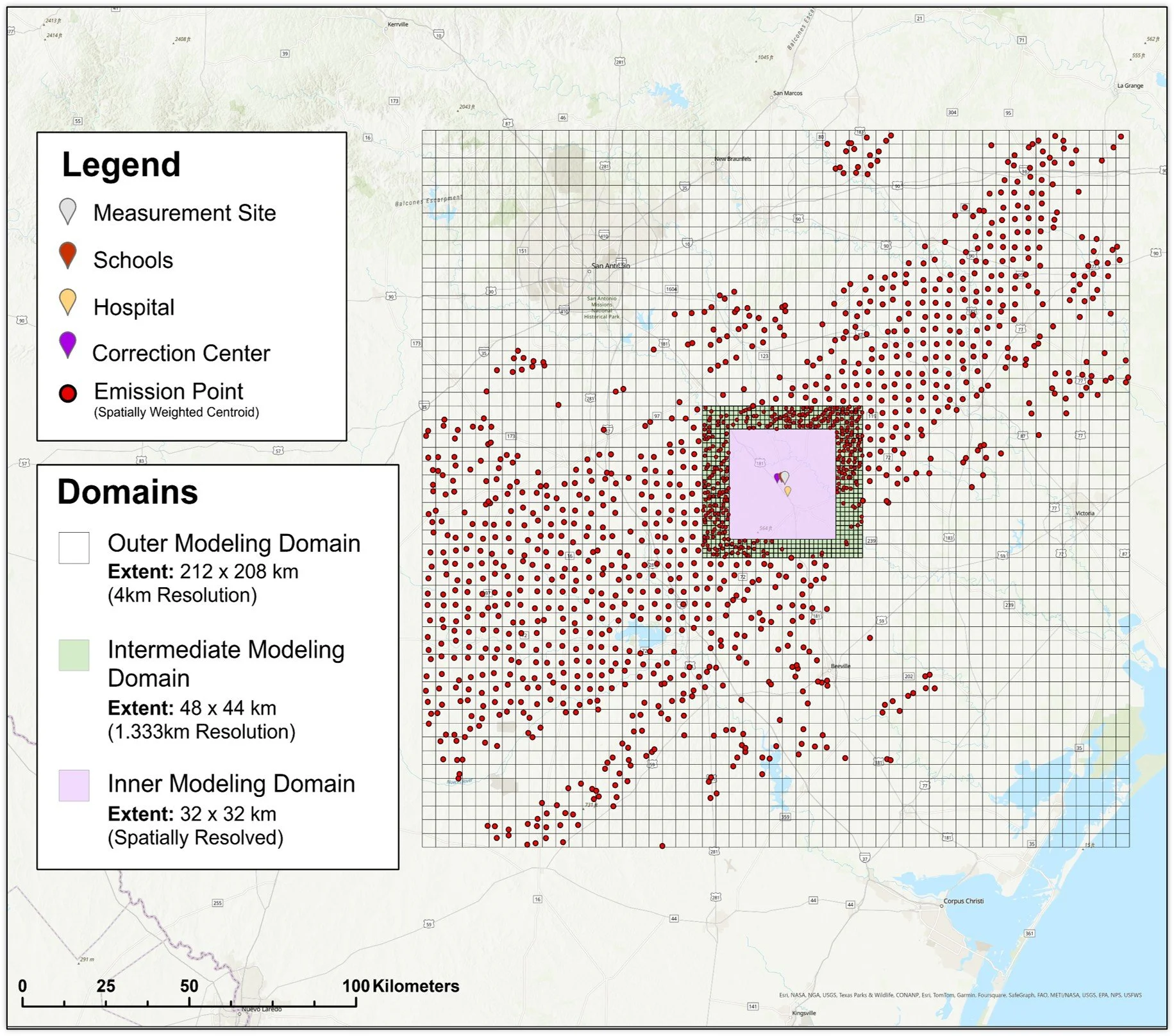
Figure reproduced from Graves, et al. (2025) licensed under CC-BY-NC-ND.
EFS Emissions Aggregation Scheme
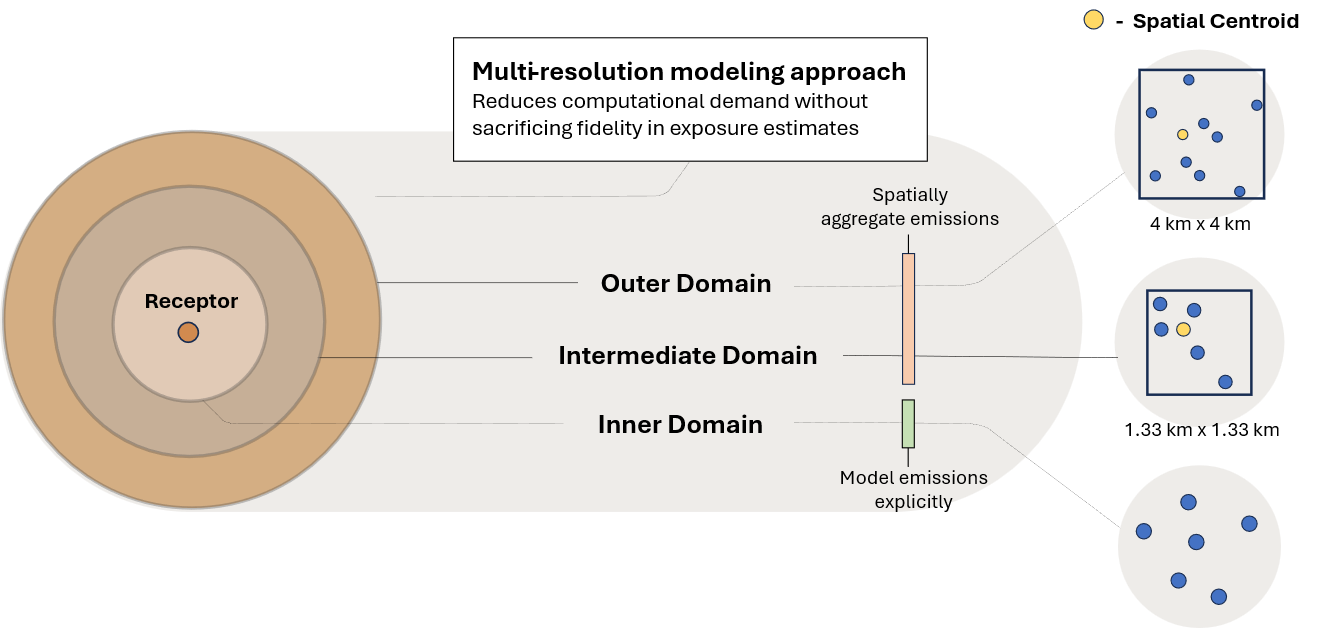
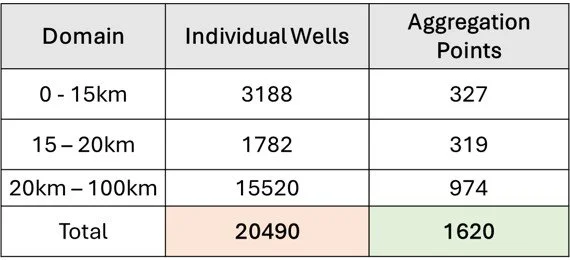
≥ 90% reduction in the number of sources included in the dispersion model
Review Detailed Eagle Ford Shale (EFS) Case Study Framework Flowcharts:
Resources
EFS manuscript: Graves, et al. (2025)
Sources for model inputs (numbers correspond to flow diagram):
Production and completion data: IHS Markit
Estimating non-combustion emissions from well sites: Methane Emission Estimation Tool (MEET)
Estimating methane emissions from gathering sites: Zimmerle, et al. Methane Emissions from Gathering Compressor Stations in the U.S (2020)
Estimating methane emissions from natural gas processing plants: Mitchell, et al. Measurements of methane emissions from natural gas gathering facilities and processing plants: measurement results (2015)
Land-use data: National Land-Use Consortium Database
Elevation data: National Elevation Dataset (3D Elevation Program Products)
Onsite meteorological data and hydrocarbon measurements: TCEQ TAMIS data request portal
Surface meteorological data (hourly): Integrated surface database
Surface meteorological data (5-minute): Automated surface observation system
Numerical weather prediction products (meteorological data): High-resolution rapid refresh
Additional resources:
Upper air soundings: Integrated Global Radiosonde Archive
General NCEI/NOAA meteorological products: NCEI/NOAA data products
Model documentation:
AERMOD
CALPUFF
Examples of alternative air quality models:
HYSPLIT Model
Community Multiscale Air Quality Model System (CMAQ)