MODELS
Emissions Modeling
Significant spatial and temporal variability in emissions from oil and gas sites
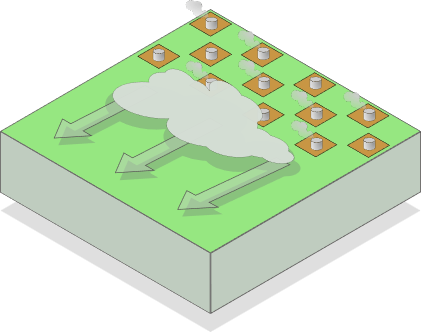
Emissions from oil and gas operations vary spatially and temporally
Conventional emission reporting methods are mostly based on annual and basin average emission factors and fail to capture spatial and temporal variability in emissions
Using a suite of emissions modeling tools, we prepared spatially-, temporally-, and chemically-resolved emissions inventories for tens of thousands of oil and gas sites in the Marcellus, Eagle Ford, and Permian production regions
Adapted with permission from Allen, et al., Variability in Spatially and Temporally Resolved Emissions and Hydrocarbon Source Fingerprints for Oil and Gas Sources in Shale Gas Production Regions Environmental Science & Technology, 51, 12016-12026 (2017). Copyright 2026 American Chemical Society
Learn more! Explore Case Studies:
Temporally and spatially resolved inventories were developed based on data from publicly available datasets and tools
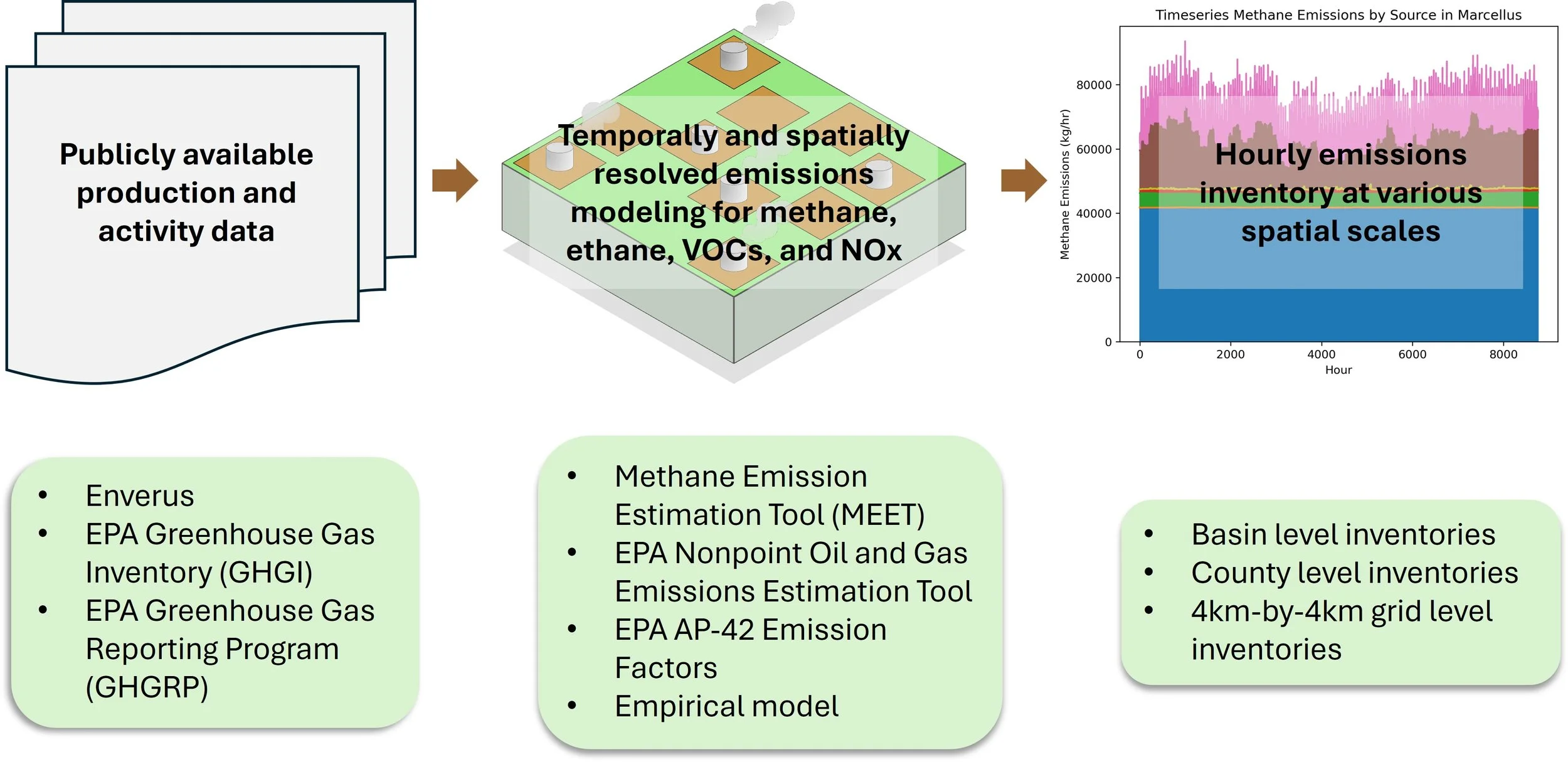
Methane emissions time series (Panel 3; right) reproduced from Chen, et al. (2025) licensed under CC-BY. “Hourly emissions inventory…” overlaid.
Species-level estimates were developed using consistent and source-specific composition profiles

Table partially reproduced from Chen, et al. (2025) licensed under CC-BY.
Air Quality Modeling
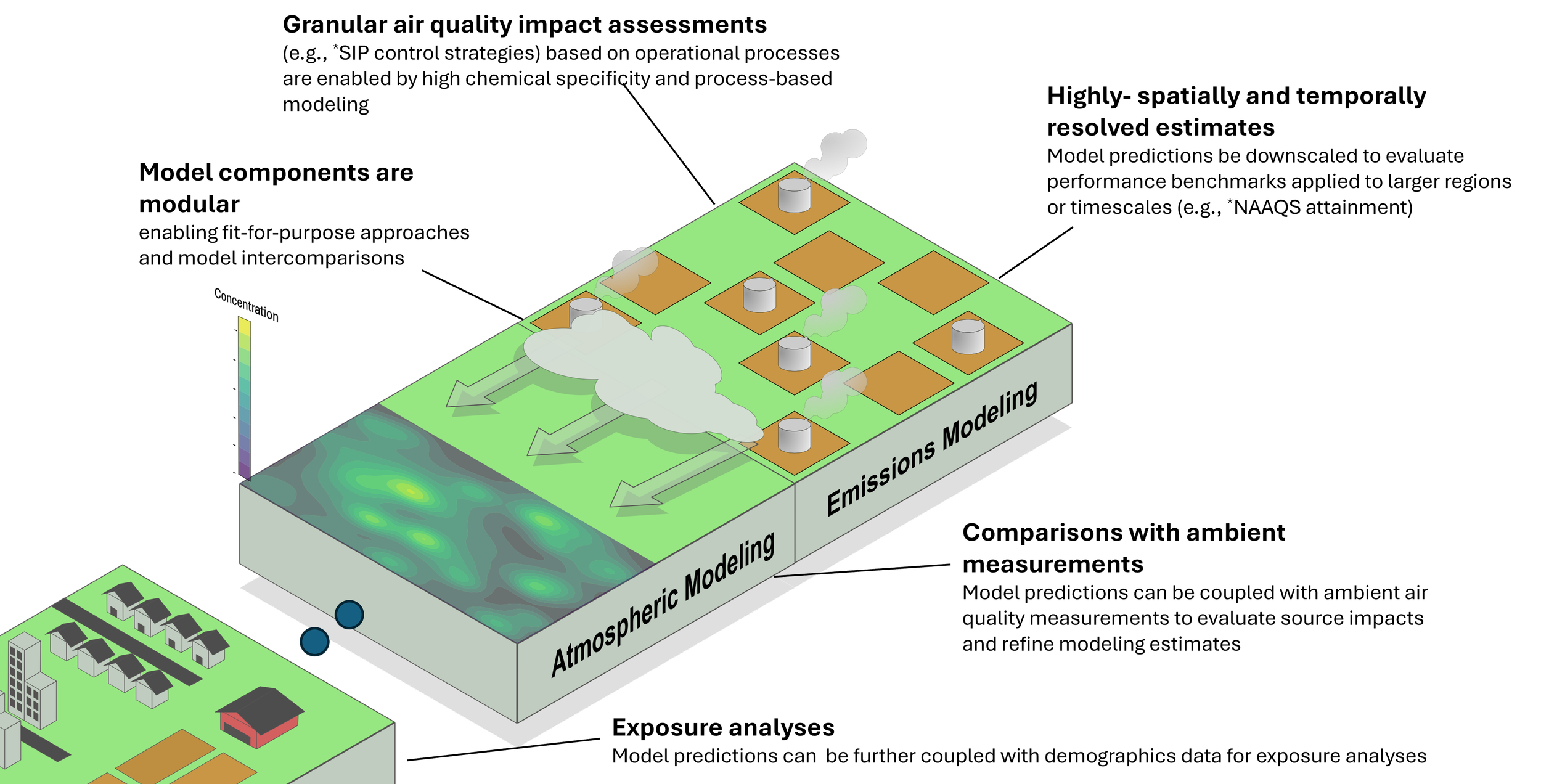
Emissions estimates are coupled with atmospheric models to predict air quality impacts
Modeling in the Eagle Ford Shale revealed sources could impact ambient atmospheric concentrations more than 50 km away
Modeling domains in the TRACER framework are selected to encompass all potentially impactful emission sources (i.e., being typically larger than 50 km × 50 km)
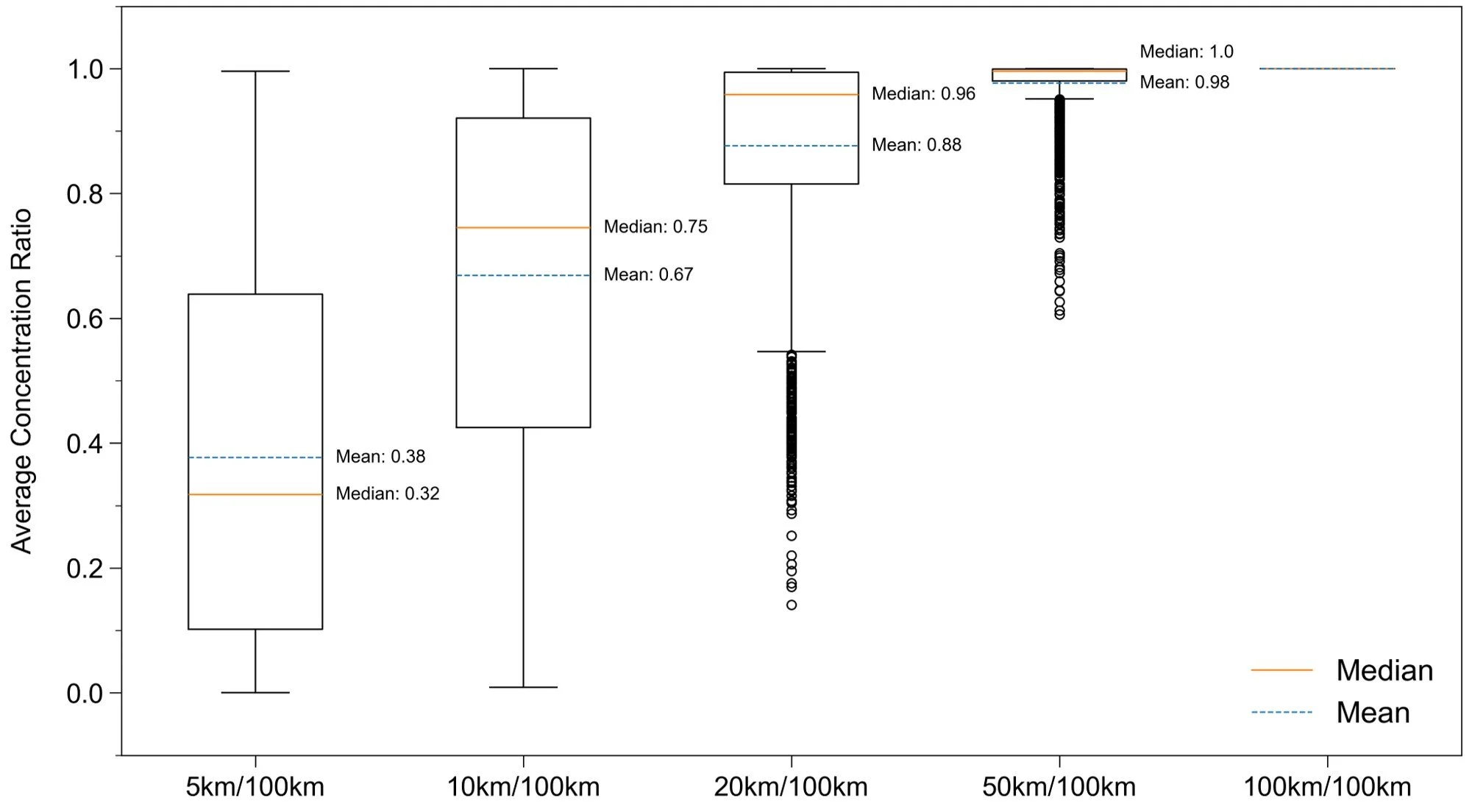
Figure: For each hour of a 3-month modeling simulation, what were the concentration contributions from sources withing n km of a centralized receptor point compared to the contribution from sources within 100km of the same point
Reproduced from Graves, et al. (2025) licensed under CC-BY-NC-ND.
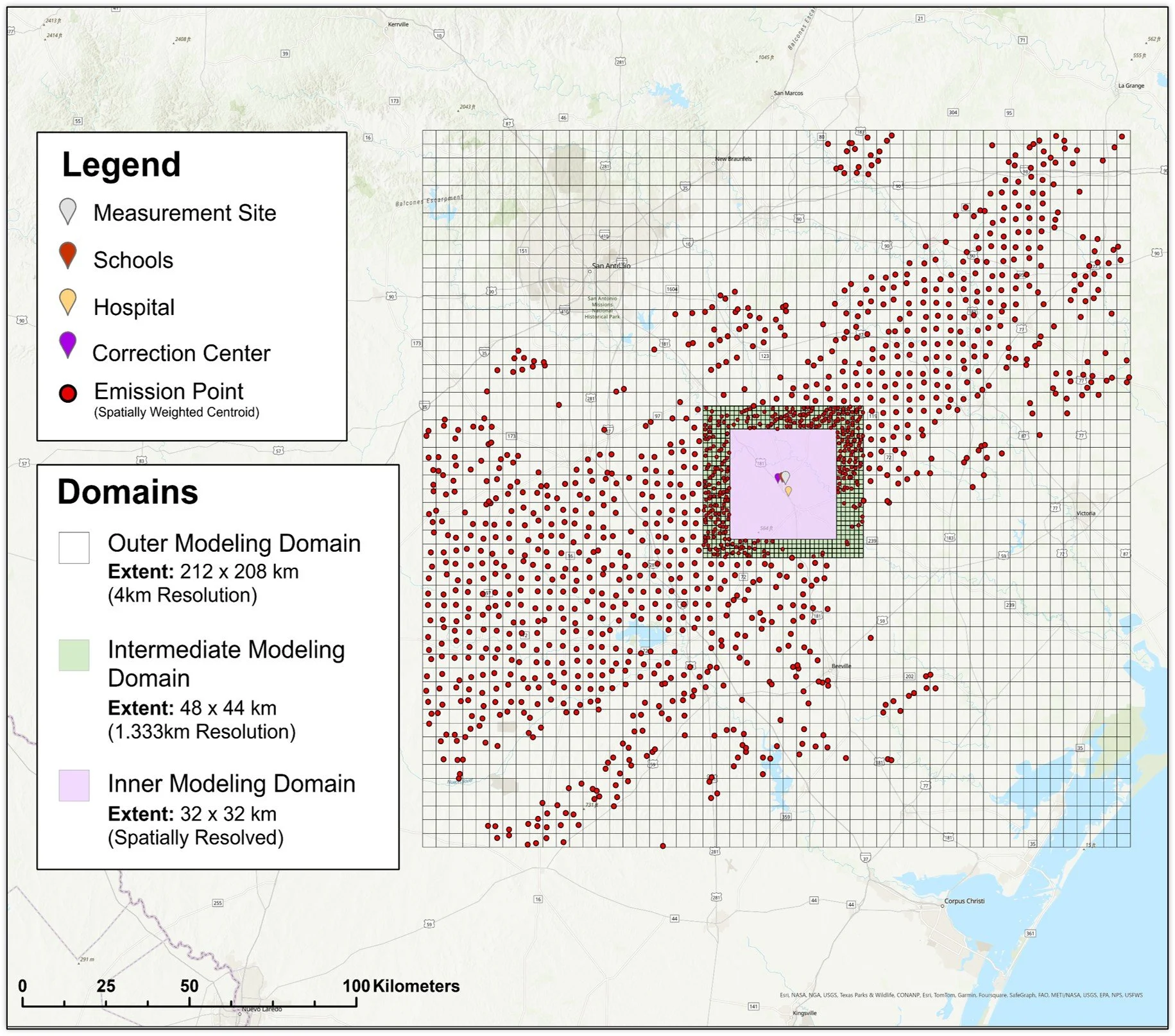
Figure: Arrangement of sources around the centralized receptor point
Reproduced from Graves, et al. (2025) licensed under CC-BY-NC-ND.
Learn more!
Modeling in the Permian basin revealed explicit treatment of distant sources (> 50 km away) enhanced predictions of ambient concentrations in this region
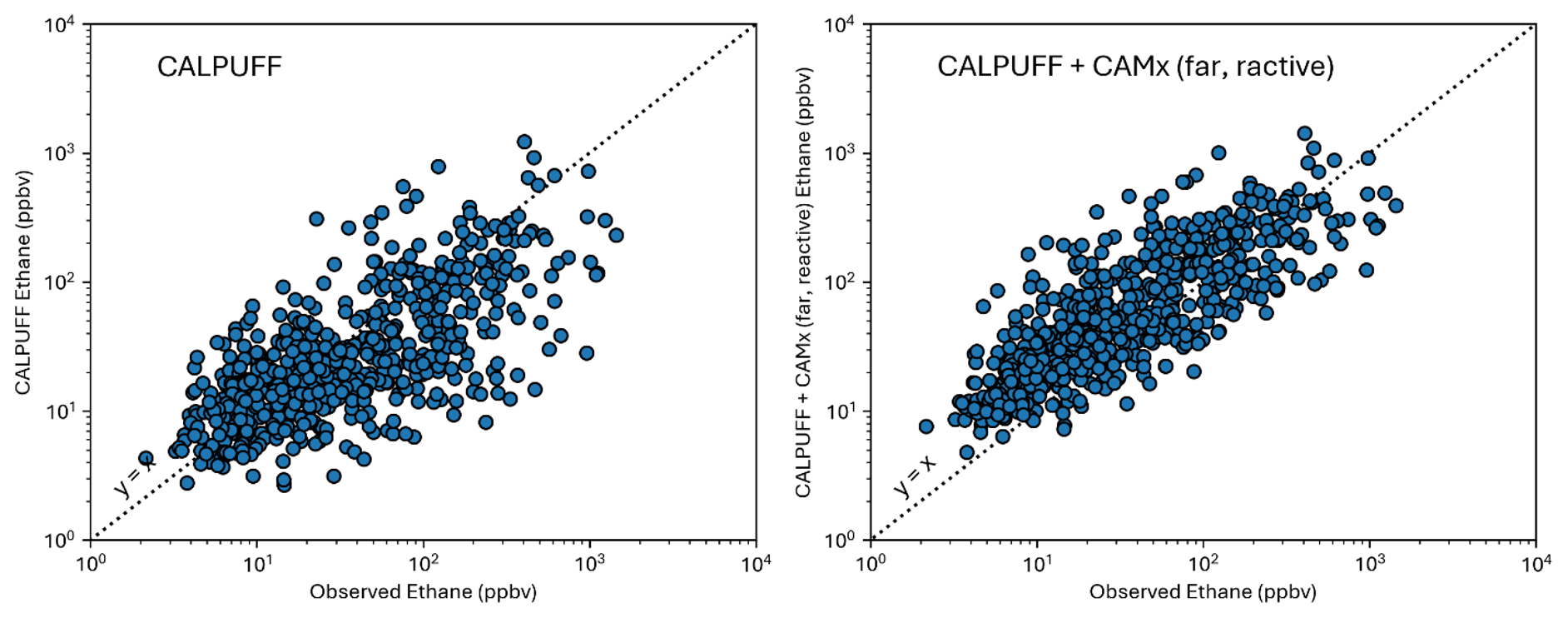
Figure: predicted concentrations plotted against observed concentrations (paired in time). Left panel shows dispersion model predictions only. Right panel shows dispersion model predictions combined with background predictions from chemical transport modeling.
Figure reproduced from Graves, et al. (2026) under Creative Commons license CC BY-NC-ND.
Learn more!
Explore how TRACER has been used
Applications: Emission event reconstruction, state implementation plans, etc.
TRACER modeling produces ambient concentration predictions with high spatial, temporal, and chemical specificity. This allows for detailed comparisons with ambient measurements to conduct source attribution or identify large, non-routine emission events unidentified by the emissions model. High specificality also allows for granular impact assessments (e.g., “what if” scenarios relevant to state implementation plans).

Figure reproduced from Graves, et al. (2025) licensed under CC-BY-NC-ND.
The TRACER framework is modular and can accommodate a variety of modeling approaches, enabling the use of methods that are fit-for-purpose in many applications. TRACER methods have been used to develop inventories for dispersion and chemical transport models and, using the predictions from these models, to evaluate local and regional source impacts on ambient concentrations. These predictions have been used to evaluate potential sources of seasonal emission patterns observed in the oil and gas supply chain.

Figure reproduced from Chen, et al. (2026) under Creative Commons license CC BY
Applications: health-effects studies, demonstrating attainment for National Ambient Air Quality Standards (NAAQS)
TRACER predictions can be downscaled to various spatial and temporal resolutions for studies interested in longer-term averages or spatially variable impacts

Reproduced with permission from Hildebrant Ruiz et al. 2026. © 2026 Health Effects Institute. Hildebrandt Ruiz L, Allen D, Misztal P, Matsui E, Peng R, Kimura Y, et al. 2026. Monitoring and Modeling Population Exposures to Air Pollutants from Oil and Gas Development: Part 1. Predictive, Source-Oriented Modeling and Measurements to Evaluate Community Exposures to Air Pollutants and Noise from Unconventional Oil and Gas Development. Research Report 240. Boston, MA: Health Effects Institute.
Applications: demonstrating attainment for National Ambient Air Quality Standards (NAAQS), environmental justice studies, evaluating emissions inventories
Coarse emissions datasets can be combined with operational information to upscale emissions estimates in space and time. These distributions can be combined with chemical transport models to evaluate the impact of aggregating emissions at various spatial and temporal scales on predicted distributions of secondary pollutant (e.g. ozone) concentrations.

Figure reproduced from Modi, et al. (2024) licensed under CC-BY-NC-ND.
Model Transport and Atmospheric Chemistry Framework
The TRACER framework can be configured using most air quality models that accept point- and area-source emissions inputs allowing modelers to develop fit-for-purpose solutions for their specific-use case. Dispersion and chemical transport models were used to develop the TRACER framework in a series of case studies.
See generalized and detailed air quality modeling framework flowcharts here.
Air quality models used in TRACER case studies
Dispersion Models:
CALPUFF
AERMOD
Single Equation Gaussian Implementation
Chemical Transport Models (CTMs):
Comprehensive Air Quality Model with Extensions (CAMx)